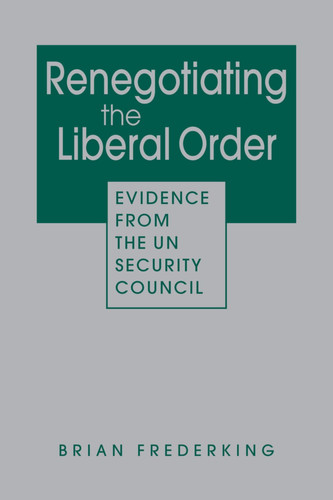
"Frederking's rigorous data-making effort produces concrete, social-scientific understandings of how liberal institutions have worked in the past.... [Such] systematic evidence will prove essential in addressing the shortcomings of the current liberal international order." --Thomas C. Walker, Perspectives on Politics Is the liberal order in decline? Can we see evidence of that decline in the UN Security Council? Brian Frederking challenges the increasingly popular "decline" narrative by examining the practices of the Security Council in the decades since the end of the Cold War. Relying on both qualitative and quantitative data, Frederking shows that the council has consistently enforced liberal rules to resolve conflicts regarding war crimes, human rights, and democracy. What many interpret as a decline, he argues, is instead a process of renegotiation--the outcome of which remains a liberal order, but one that is less influenced than in the past by the US and its allies. CONTENTS: The Security Council and the Liberal Order. The Rules of World Politics. The Critics of Collective Security. The Collective Security Dataset. Saying No on the Security Council. Punishing War Crimes. Supporting Human Rights. Defending Democracy. Threats to the Liberal Order: Russia and China. The Ambivalent Hegemon: The United States. Renegotiating the Liberal Order.
| ISBN-13: | 9781955055864 |
| ISBN-10: | 1955055866 |
| Publisher: | Lynne Rienner Publishers |
| Publication date: | 2023 |
| Pages: | 203 |
| Product dimensions: | Height: 9 inches, Length: 6 inches, Weight: 0.80027801106 pounds, Width: 0.75 inches |
| Author: | Brian Frederking |
| Language: | en |
| Binding: | Hardcover |
Discover more books in the same category



